When a lengthy article appears in a publication with a distinguished name and a long history, readers often assume that it’s accurate and true. I used to make that assumption too. Increasingly, I think it is a dangerous one.
I have been the subject of enough magazine profiles to know the drill. It takes a tremendous amount of time to respond to every anonymous accusation or creative interpretation of events, particularly when you know that your response will ultimately be presented through someone else’s filter and wind up in an article few will read.
The latest piece in The New Yorker seemed worth responding to, not because of the article itself, but because it presents such a vivid example of how the process works.
The article revisits several familiar accusations that have surfaced over the years, which are false and contradicted by the record. Many of these claims were answered years ago. Others rely on anonymous sources offering accounts of conversations that I know never happened. And in most instances, information we provided during The New Yorker’s storied fact checking process somehow failed to correct their preferred narrative.
The problem is that once something like this is published, it takes on a life of its own. Other publications repeat it. Social media amplifies it. AI absorbs it. Some deliberately exploit it. Before long, an anonymous allegation has been repeated enough times that it becomes accepted as fact. I see people repeating some of these allegations with genuine anger. I understand it. If I believed they were true, I would be angry too. But repetition doesn’t make something true.
So, I thought I would try something I have never done before. I am publishing my own fact check.
Below runs through some of the major claims and insinuations from the article followed by my response, along with names, dates, documents and records that readers can consider for themselves. There are even a few places where The New Yorker inadvertently helps with the fact checking by making claims that contradict each other. For example, the article suggests that foreign investors invested with me in 2021 to gain influence, despite the fact that they did so two years before President Trump even announced he was running again. Later, the article quotes a source complaining that those investments produced financial returns but no influence over U.S. policy. That fact undercuts the article’s own theory of why the investments were made.
I don’t expect everyone to agree with my business decisions, my efforts to help the U.S. where I can, or my approach to diplomacy. Criticism and disagreement are part of public life. But people should at least have access to the facts before they come to any conclusions about me (or anyone else).
For years, I thought the best response to inaccurate allegations was not to dignify them and keep working. The downside is that an unanswered allegation can eventually become accepted fact through repetition.
The article also relied on questionable journalistic practices. It repeatedly granted anonymity, not to reveal otherwise unobtainable facts of public importance, but to allow unnamed sources to make personal attacks and wisecracks without accountability. It also attributed to me remarks from a White House background briefing, even though the reporter was not present at the briefings, and then he knowingly participated in a breach of journalistic standards by using them without consent. The White House Correspondents’ Association condemned the breach, warning that violating such agreements “jeopardizes our ability to continue receiving useful information” and urging reporters to “maintain high standards of journalistic ethics.”
At a minimum, these techniques tell readers something useful about the standards applied to this New Yorker article. I don’t intend to spend my time responding every time one of these allegations resurfaces or every time an article gets something wrong. There is too much important work to do. But I will occasionally add to this document as the need arises. Meanwhile, the facts, my responses and the underlying evidence will now be here for anyone who wants them. Then I can get back to work.
With that in mind, let’s look at the facts.
Jared
1. Affinity Partners’ Fundraise
Claim
Earlier this year, as Kushner engaged in talks with Iran, he was also discreetly raising another five billion dollars for Affinity in the Middle East. After the attacks on Tehran began, suspicions arose that the two endeavors were linked. “My sense is that he thinks he was killing two birds with one stone, he was helping the Arabs defeat the Iranians, and he wanted to be paid for it,” an American with deep ties to Middle Eastern leaders told me.
Reality
I have raised no additional funds for Affinity Partners since President Trump was elected to his second term.
Once a certain percentage of a fund’s initial capital has been committed, it is standard practice to consider a potential future vehicle. The instant the actions in Iran began and I was asked to extend my volunteer role, I ended all conversations about additional fundraising.
On March 19, 2026, The New York Times reported that Affinity's chief legal officer, Ian Brekke, acknowledged “early conversations” while making clear that the firm “does not intend to take in any additional capital while Jared is volunteering for the government.”
I also told The New Yorker during its fact-checking process that no additional capital had been raised. That distinction matters. Preliminary conversations about a possible future fund are not the same thing as raising a fund, yet the article stated that I was “discreetly raising another five billion dollars” while engaged in talks with Iran. That sentence was beyond misleading.
The predictable result was that other publications converted that wording into an asserted fact. The New Republic reported that “Kushner managed to raise $5 billion for his group, Affinity Partners.” Mediaite similarly reported that I had raised $5 billion while negotiating with Iran.
That did not happen. Affinity has raised zero additional capital during this period. Zero.
This is a useful example of why precision matters. A preliminary conversation became “raising” $5 billion, which then became, in subsequent coverage, $5 billion actually “raised.” The latter claim is objectively false.
We contacted both publications to correct the record, but they have declined to do so.
Scrutiny should begin with accurate facts. In this case, the relevant fact is straightforward: while I have been volunteering for the government, Affinity has not raised additional capital.
2. Conflict of Interest Claims
Claim
“Kushner is plagued with conflicts of interest,” Virginia Canter, a former White House counsel, said. “He is supposed to be working for the American people, but in fact he has tremendous financial incentives to further the interests of his investors.”
He represents a new kind of Washington figure, for whom public office serves as a means to extraordinary wealth. In the past two years, an array of people linked to the White House ... have used their official positions to bring in billions of dollars for themselves. “I know all these guys,” a former American official who served in the Middle East told me. “They go into these meetings, and they are doing business right alongside their diplomacy. ‘O.K., enough about the ceasefire. We have this hotel we want to build.’ That’s the kind of foreign policy America has now.”
Reality
I have never taken a diplomatic action to benefit Affinity, myself, or any investor.
This accusation has been mentioned since I first served in government in 2017, but over the past decade, no one has identified a single American position I changed, government favor I sought, or diplomatic decision I made in order to benefit myself, Affinity, or one of its investors. Allegations of conflicts should ultimately be tested against specifics: What action did I take, whose financial interest did it benefit, and what evidence shows that the two were connected? Generalized suspicion is not a substitute for answering those questions.
Serious allegations should be supported by specific facts, not generalized theories from unnamed sources.
In fact, the article itself includes evidence that cuts against its premise. An anonymous former senior U.S. official claims that Gulf governments invested in Affinity expecting that it would give them influence, but then says they were disappointed because “they thought that would bring them some influence that would protect them, and it did the opposite.”
I cannot speak to what any investor privately hoped or expected. I can speak to my own conduct. Affinity’s investors have never influenced my diplomatic positions, and I have never used my public role to advance their commercial interests. My diplomatic work should be judged by the positions I took and the decisions I made.
I have outside ethics counsel, and the White House Counsel’s Office has also reviewed the circumstances in connection with my volunteer government work. Both have confirmed that I am complying with all applicable ethics rules and requirements. I receive no salary or other compensation from the government for this work and pay my own expenses. I take these obligations seriously and will continue to work with counsel to monitor my circumstances and ensure ongoing compliance.
I served for four years in the first Trump Administration, taking no salary, and am proudly volunteering again now. When given the opportunity, I have prioritized service and impact. I am proud of that choice. The record of my conduct over an extended period, not speculation about my motives, is the appropriate basis on which to judge that choice.
Claim
Phoenix Financial investment as a “conflict”
Reality
Last week, CNN published another story built around the same kind of insinuation. The headline reads “How Jared Kushner’s firm’s investment in an Israeli company could be a major conflict of interest.”
This is another example of a troubling journalistic practice: use a sensational headline that implies wrongdoing, while placing the underlying reporting, and the important facts that substantially qualify the headline behind a paywall. Many readers will see the accusation without ever seeing that CNN’s reporting found no evidence of a conflict of interest.
Affinity Partners bought public stock in Phoenix Financial, one of Israel’s largest blue-chip, highly regulated, diversified financial-services companies. Affinity does not own any of the nine defense-related companies identified by CNN, and I have never participated in or directed Phoenix’s decisions to buy, hold or sell those investments.
Think of Phoenix as the Israeli equivalent of Fidelity or Vanguard: a large financial institution managing retirement and other savings across thousands of investments. I have no role in choosing those underlying investments. Investments which apparently constitute only a fraction of a percentage of Phoenix’s assets.
Most importantly, CNN acknowledges in the article that it “found no indication that Kushner’s actions as a diplomat directly affected the investments reviewed.” CNN also reports that Phoenix had invested in Elbit Systems for more than a decade, years before Affinity became a shareholder.
The article does not mention that Affinity made its investment in Phoenix before the 2024 election. And I have been transparent about why we invested in Phoenix: we believed in the fundamentals of the company. The market has since validated this thesis as the stock has risen 5X since we invested. I have also consistently believed that greater economic integration between Israel and its neighbors can help create constituencies for peace. This is a philosophy I have advocated publicly for years.
Since becoming substantially more engaged in volunteer public service, my interaction with Phoenix management has been significantly reduced. Again, I receive no compensation for my government work, pay my own expenses, and my diplomatic work is undertaken at the President’s request. I have never taken a diplomatic action to benefit Affinity, myself, or any investor. This article, while full of insinuation, is devoid of any facts that demonstrate otherwise.
3. PIF’s Investment in Affinity
Claim
There’s no direct evidence that the Saudis intended to reward Kushner or Trump for their actions in office. But the former American intelligence official who worked in the Middle East told me that Kushner’s help in salvaging U.S.-Saudi relations after Khashoggi’s murder would have created a debt for M.B.S.
Reality
There was no understanding, promise, expectation, or arrangement linking PIF’s investment in Affinity to anything I did in government, and there has never been any evidence produced that says otherwise. PIF’s investment in Affinity was made after I left government, with no desire, plans or prospects to return to diplomacy, and years before President Trump decided to run again. And its investment was made on commercial terms and after going through a full diligence and review process by some of the most prestigious and rigorous investors in the world (and their lawyers and consultants).
Before entering government in 2017, I had already built a successful investment career and generated billions of dollars in profits for my investors and partners.
In fact, the Wall Street Journal independently reported that PIF wanted to work with me “in part because [they] felt [my] work on the Abraham Accords demonstrated considerable business acumen” and also that I was seen as an expert on the Middle East with an ability to bring Gulf investments to Israel.
From the outset, part of Affinity’s investment thesis was to deepen economic ties and connectivity across the Middle East by bringing Arab capital into the Israeli market; our investment was one of the first known instances in which Saudi Arabia’s Public Investment Fund waived its restrictions on investing in Israel.
All of the investors in Affinity are savvy, blue-chip investors that made an investment on commercial terms, during a time when I had left public service and intended to build on my past experiences and successes to create a new investment firm. I am proud of these partnerships, and my partners are pleased with the objective success we have experienced together.
4. Affinity’s Fund Performance
Claim
Affinity estimates its annual internal rate of return at twenty-five per cent.
Reality
Affinity is an SEC-registered investment advisor. We track performance of the fund through several metrics, including internal rate of return. However, we do not publish our performance numbers for anyone other than our current investors, and they change by the quarter, though they do serve as an objective way to evaluate the fund. We do publish our assets under management each year in our SEC filings, which show our assets growing from our investment performance (we have not raised new funds in years).
Much of the criticism of Affinity has rested on the theory that sophisticated investors committed capital primarily to gain political influence or reward me for my government service. Yet no evidence has been produced showing that an Affinity investor received a diplomatic favor in exchange for its investment.
Meanwhile, the fund’s financial performance provides the most straightforward commercial metric by which our investors evaluate us.
5. My Investment Experience
Claim
A due-diligence investigation found the firm’s operations “unsatisfactory in all aspects.” As a friend of Kushner’s put it, “Jared had never invested in more than a 401(k).”
Reality
The claim that I had “never invested in more than a 401(k)” is contradicted by my record in business and by facts contained in the article itself.
Before entering government, I invested billions of dollars in real estate, generated substantial profits, founded technology companies, seeded a technology investment firm and owned the New York Observer. I began investing in apartment buildings at 19 while still in college and had already made millions from those investments by graduation.
The article acknowledges much of this history, yet still gives an anonymous source space to claim that I had “never invested in more than a 401(k).” Those two things cannot both be true.
My subsequent record at Affinity, which is an SEC-registered advisor, provides additional objective evidence by which to evaluate my investment experience. Our assets under management have continued to grow from investment gains, not newly raised capital.
Anonymous sources can be valuable when they provide information that could not otherwise be obtained and then can be confirmed. But an anonymous wisecrack that is contradicted by readily available facts shows the desired narrative of the author and does not help readers understand the subject.
6. Affinity’s Practices and Fees
Claim
“The Saudi contributions promised huge incomes for Kushner and his team, no matter how well the fund performed. With a management fee of 1.25 per cent, the fund would receive more than twenty-five million dollars a year, plus twenty per cent of any profits.” … “Nearly three years into a five-year investment term, Affinity was managing three billion dollars of its clients’ capital but had invested barely a third of it. In the same period, the Finance Committee estimated, it had collected a hundred and fifty-seven million dollars in fees.”
“Senator Ron Wyden, among others, suspected that Affinity was just a vehicle for Gulf leaders to enrich Kushner. (Kushner’s spokesman denied this.) Wyden noted in a letter to Mizelle that, if Trump was elected to a second term, the investments would give the Gulf states enormous leverage. The Administration “will have financial motives to make foreign policy decisions that may be counter to the national interest in order to ensure Kushner and Ivanka Trump continue to collect millions of dollars in fees,” he wrote.”
Reality
The criticism here rests on a misunderstanding of how private equity funds work and, more importantly, on treating an early snapshot of a long-term investment fund as though it were a final measure of its performance.
Affinity is structured like other private equity funds. Investors commit capital that is deployed over a multi-year investment period, management fees support the team and operations during that period, and investment gains are realized over the life of the fund. Affinity does not receive its share of investment profits until its investors have first received back their capital and fees together with an 8% preferred return.
Bill Ackman, the founder and CEO of Pershing Square Capital Management, made this point publicly when similar criticism emerged on September 27, 2024:
“Kushner’s fund, Affinity Partners, is a private equity fund structured like other private equity funds. The fund has an investment period of five years where the manager can draw capital to make investments, but it has no requirement to return capital until the end of the fund’s life, which with extensions could be 10 years or more. Investors in private equity funds don’t expect distributions in the early years during the investment period, particularly in an environment which has not been conducive to realization events like IPOs and sales due to the rate environment. Management fees are charged before profits are earned because that enables the manager to compensate his team and cover other expenses. That is how every private equity fund is structured. There is nothing untoward about Jared Kushner or his fund. What is untoward is that we have media organizations that work to advance their political objectives without regard to the truth.”
Affinity was deliberately patient deploying capital in its early years. We believed valuations in 2021 were unusually high and chose not to invest for the sake of putting money to work. As the market corrected in 2023, our pace of investment rapidly increased and the deployment numbers cited in the article are false.
Private equity funds should ultimately be judged by the returns they generate for their investors, not by how quickly they deploy capital or distribute gains during the early years of the fund.
The article also repeats a false $157 million estimate of Affinity’s fees that originated in Senator Wyden's 2024 investigation. That number was not presented to us during The New Yorker’s extensive fact-checking process, so we had no opportunity to address it before publication. It is inaccurate and does not reflect the actual amount of fees earned by Affinity.
There is nothing improper about scrutinizing Affinity’s fees, investment pace or performance. Those are measurable questions. But they should be evaluated using the actual economics of the fund and its current performance. Again, Affinity is an SEC-registered firm and we are limited in what we can publish or confirm. We do disclose our assets under management in our SEC filings, which continue to grow from investment performance, because we have not raised new funds in years. Those measures, along with more detailed performance numbers that we share with our investors, are the metrics by which our firm should be judged.
7. Saudi Internal Politics
Claim
M.B.S. called Kushner to discuss his plans, in a conversation that was secretly recorded. “Kushner told M.B.S. that everyone in the U.S. government except the intelligence agencies was behind him,” a former regional intelligence official told me, explaining that he had seen a transcript of the call.
“It was the green light.” (Kushner’s spokesman denied this.)
Reality
This conversation never occurred. There is no transcript. Journalists basing allegations on an anonymous source supposedly having seen a “transcript” of a call should at the very least authenticate that the conversation actually took place. The New Yorker did not provide a transcript, and I unequivocally deny having the conversation described here.
Claim
“The main motive that Trump had for tilting toward M.B.S. was to stick it to the [CIA].”
Reality
The claim that President Trump’s “main motive” for working with Crown Prince Mohammed bin Salman was to “stick it to the CIA” is an anonymous source’s speculation about the President’s motives, and it ignores the substantive reasons for the relationship that were articulated publicly at the time.
From the beginning, President Trump’s approach was that we could not defeat terrorism just by killing terrorists. We also had to defeat the extremist ideology that produced them, cut off their financing, and encourage our partners in the region to take more responsibility for their own security and future. Saudi Arabia, as the largest economy in the Gulf and home to Islam’s two holiest sites, had an important role to play. We wanted Saudi Arabia to do more to combat extremism, stand with us against Iran’s destabilizing activities, invest in the United States and create American jobs, and modernize their economy and society. Those were all priorities we discussed openly from the beginning of the Administration.
Mohammed bin Salman had alignment with that vision and was putting forward an ambitious vision that moved in many of those same directions. Vision 2030 was about modernizing the Saudi economy and society, creating opportunities for a young population, promoting greater tolerance, and opening the Kingdom to the world. He also wanted a much deeper economic and strategic relationship with the United States. During President Trump’s 2017 visit to Riyadh, we worked with the Saudis to turn those shared objectives into concrete commitments: confronting ISIS and other terrorist groups, attacking terrorist financing and extremist ideology, countering Iran, increasing regional burden-sharing, and substantially expanding Saudi investment and economic cooperation with the United States.
The Kingdom subsequently undertook significant economic and social reforms that we take for granted today but at the time seemed impossible, including allowing women to drive, relaxing the guardianship rules and expanding opportunities for women, and loosening longstanding social restrictions. For decades, the United States publicly encouraged these changes as part of a broader effort to support modernization, economic opportunity and a more tolerant region. International institutions, including the IMF, also encouraged many of the economic reforms contained in Vision 2030.
The partnership produced concrete results. In 2017, Saudi Arabia hosted the historic Arab Islamic American Summit, bringing together leaders from more than 50 Arab and Muslim nations around a shared commitment to fight terrorism, confront the extremist ideology that fuels it, and have countries in the region take greater responsibility for their own security. We established the Terrorist Financing Targeting Center in Riyadh, co-chaired by the United States and Saudi Arabia, to identify and disrupt terrorist financing. The visit also produced nearly $400 billion in announced agreements and investments between our countries, which the Administration said would create thousands of American and Saudi jobs. And Saudi Arabia began breaking down longstanding barriers with Israel, ultimately opening its airspace to Israeli commercial flights and helping create the conditions for greater regional integration and the Abraham Accords.
There were legitimate American policy reasons to strengthen our working relationship with Saudi Arabia and Mohammed bin Salman. One can agree or disagree with that policy, but reducing it to an anonymous assertion that the President’s “main motive” was personal animosity toward the CIA substitutes speculation for the extensive contemporaneous record of what the Administration was actually trying to accomplish.
8. Looking to displace Gazans or Profit from Reconstruction
Claim
At Harvard in 2024, he had said that the best place for residents of Gaza would probably be in Israel’s Negev Desert. He didn’t explain how they would be compelled to move, or whether they would be permitted to return. In his description, Gaza is a dystopian place, “built by N.G.O.s and terrorists.” … elsewhere the article reads “where others saw desolation, Kushner saw a development opportunity.”
Reality
These passages combine two very different comments to imply something I neither said nor advocated: permanently displacing Palestinians and turning Gaza’s reconstruction into a business opportunity.
At Harvard in February 2024, a year before President Trump returned to office, I was discussing how Israel could continue military operations against Hamas while minimizing civilian casualties. As one idea, I suggested temporarily moving civilians out of the battlefield to a secure area in the Negev and explicitly said that I did not believe Israel had stated they would be prevented from returning afterward. I was not advocating permanent displacement. I was discussing how to get civilians out of harm’s way during a war and allow them to return when it was safe.
My comments about Gaza’s waterfront made a different point. If not governed by a designated terrorist group committed to the destruction of Israel and instead governed to maximize the benefit to the Palestinian people, Gaza has enormous unrealized economic potential for the Palestinian people. Instead of investing billions in tunnels and weapons, those resources could fund infrastructure, education, businesses, innovation and better lives for Palestinians.
Turning that observation into a suggestion that I saw a personal “development opportunity” is particularly misleading and offensive. I have never pursued any business opportunity in Gaza, sought to acquire property there or sought to profit from its reconstruction. My work on Gaza is not, and has never been, a business venture.
I work on Gaza because I believe Palestinians can have a radically better future and that creating one is essential to a durable peace in the region. We are trying to create a new incentive structure where Palestinians have more to gain from peace and prosperity, Israelis can live securely and comfortably, and another generation is not condemned to repeat the same cycle of conflict.
During the United Nations General Assembly in September 2026, our team presented the Board of Peace’s practical plan for Gaza’s reconstruction, including Palestinian civilian governance, demilitarization, housing, hospitals, schools, infrastructure, small-business recovery and an economy that creates jobs and opportunity. The goal is not to move Palestinians out of Gaza, but to build a secure, prosperous future in which Palestinians can thrive, and Israelis can live safely alongside them.
9: Development in Albania
Claim
[Kushner] had been awarded development rights without public notice or competitive bidding, and that the amendment to unlock protected land had been rushed through parliament. Rama even allowed an airport to be built inside the preserve.
Reality
The land was not awarded to us by the Albanian government. Our partnership purchased it from a private party for €230 million in a private transaction, among the highest prices paid in the region for a transaction of this scale. Title was reviewed by counsel and verified.
This project began as a straightforward private real-estate investment based on our belief in Albania’s potential as a rising destination and the opportunity to create something truly special there.
We are investing substantial private capital, betting on a country that has never had a project of this scale. There are no guarantees. We are taking that risk because we believe in Albania and we believe in Albanians. If successful, the project could represent approximately €4 billion of investment and create significant jobs, economic activity and international visibility for Albania.
Since acquiring the land, we have spent more than three years and tens of millions of dollars studying the site, its environment and the opportunities and needs of the region, while assembling exceptional architects, designers, engineers, environmental experts and partners to shape the project responsibly. The goal has never been simply to develop the land, but to create something that can become a platform for opportunity and long-term growth for Albania.
Asher Abehsera, a longtime friend and business partner with a track record of successful development, joined as a partner and CEO of the project and has led the day-to-day work for the past four years.
The Kastrati family, a reputable Albanian business family with deep roots and great pride in their country, originally brought us the land opportunity and shares our belief in Albania’s potential.
I first met Ramez and Moutaz Alkhayyat in Doha during the 2022 World Cup and was impressed by their story and capabilities. They had fled Syria as refugees under the brutal Assad regime, with many of their properties and holdings later confiscated by the government and were given the opportunity to rebuild their lives and businesses in Qatar. Their arrival coincided with Qatar’s enormous construction needs ahead of the World Cup, and they became deeply involved in Doha’s transformative build-out.
That is an important distinction: this is an investment, not something we were given. We purchased the land for €230 million, are committing substantial additional private capital and bear the risk of whether the project succeeds. If it does, Albania will benefit through jobs, tourism, economic opportunity and long-term growth.
My own focus has principally been on the vision and design, bringing together exceptional architects, partners, designers and creators to create a destination unlike anything else in the region. I am a minority partner and do not have day-to-day involvement in the project.
The partnership has engaged extensively with the local community in Vlore. We also understand that people have legitimate questions and concerns. The project will have to go through all relevant Albanian regulatory and environmental processes and earn the approvals necessary to proceed.
Our ambition is to build to the highest design and environmental standards and leave this extraordinary part of Albania greener, more biodiverse and environmentally stronger.
The suggestion that this project advanced to curry favor with President Trump also gets the chronology backwards. As the article itself notes, our interest began in the summer of 2021, when I was a private citizen and long before President Trump announced his 2024 campaign.
The same is true of the airport. The article implies, but doesn’t quite say, that government officials approved the airport at my behest. In fact, the airport was already approved by the time I first saw the project and was one of the factors that attracted me and informed my vision for what the region could become.
Ultimately, Albania will decide whether the project proceeds. If approved, I hope we can create something Albanians are proud of and that families from Albania and around the world will enjoy for generations.
10. Security clearance
Claim
American intelligence agencies had restricted Kushner’s access to top-secret materials, out of concern that his business interests made him susceptible to exploitation by foreign adversaries.
Reality
This is inaccurate and is contradicted by the record of what actually occurred. Business and financial interests are routinely examined as part of the security-clearance process, but I am unaware of any evidence that U.S. intelligence agencies determined that my business interests made me susceptible to blackmail or restricted my access for that reason.
In fact, Carl Kline, the career White House official responsible for the clearance adjudication, testified under oath that he was not pressured or directed by anyone to grant my security clearance and that there was no outside intervention in his decision. I ultimately received my permanent Top-Secret clearance.
There was reporting about foreign officials discussing whether they could exploit my business interests. That is to be expected with anyone in power and very different from U.S. intelligence agencies concluding that I was susceptible to blackmail and restricting my clearance on that basis.
11. How Steve Witkoff and I Handled Negotiations and Approach Diplomacy
Claim
But neither Kushner nor Witkoff brought a technical adviser to the talks; though an expert from the Department of Energy had been assigned to Witkoff, he wasn’t in the room. (The White House denied this.)
Reality
That is false. Jon Kreykes of Oak Ridge National Laboratory, the most senior nuclear nonproliferation expert in the United States Government, participated in the talks, along with State Department Iran experts and Department of Energy representatives. IAEA Director General Rafael Grossi also participated in meetings.
Claim
Kushner, who is forty-five, has little regard for the craft of diplomacy.
When the two began work on Ukraine, they had very little understanding of the war, a former senior Trump foreign-policy official told me.
Reality
I have the greatest respect for those who have committed their lives to public service and I continue to, engage with, read about and learn from them. But my approach to diplomacy is intentionally unconventional. I start with a clear end state, work backward, challenge assumptions that have kept a conflict stuck, and focus on each side’s actual constraints and incentives. I try to build trust and find practical trades that can create a durable solution.
That approach should be judged by its results.
During the first Trump Administration, I helped negotiate the USMCA and China trade agreements, the Abraham Accords and the Al-Ula agreement that ended the three-year GCC dispute. I also helped lead the passage of the First Step Act and the successful efforts to bring the 2026 World Cup and 2028 Olympics to the United States.
These achievements provide tangible evidence that the approach delivers results, including breakthroughs on issues where decades of conventional diplomacy had failed to produce progress. In President Trump’s second term, he asked me to volunteer my time on Gaza. That work contributed to a ceasefire and the return of all remaining living and dead Israeli hostages from Gaza. We have also worked with the United Nations and World Food Program to surge historic amounts of aid into the former war zone. According to UNICEF, hunger in Gaza plummeted immediately following the 2025 ceasefire amid the expansion of humanitarian aid, with surveys in mid-2026 showing acute hunger affected less than 1% of children.
There remains substantial work to do on demilitarization, reconstruction, governance and economic development, and I continue to work with our team toward a future in which Israelis and Palestinians can live with greater security and opportunity.
My involvement in the Russia-Ukraine conflict followed that work. I participate in these efforts because I believe that trying to end wars that are killing people, destroying communities and destabilizing regions is worthwhile. I am willing to speak with people on all sides if doing so can help create a path toward durable peace.
My work during the first Trump Administration was recognized with several honors, including Mexico’s Order of the Aztec Eagle, the Middle Cross of the Hungarian Order of Merit, the National Security Medal, the Department of Defense Medal for Distinguished Public Service, Morocco’s Grand Cordon of the Order of Ouissam Alaouite and a Presidential Commendation for my work on Operation Warp Speed. I was also nominated for the Nobel Peace Prize in 2021.
12. Russia-Ukraine Business Deals
Claim
Some observers suspect that Russia has effectively offered the Americans business deals in exchange for a favorable peace agreement.
The document mentions people who might participate, including Trump, Witkoff, and Kushner.
Reality
I have not seen the document described in the article listing potential contracts or participants.
Commercial issues are an important component of the negotiations, but the discussions in which I have participated have concerned potential economic benefits for the United States and the parties to an eventual peace agreement; never personal business opportunities for me, Affinity, Steve Witkoff or other members of the negotiating team.
Economic issues are an important part of these negotiations because a durable peace should create benefits that make future conflict less attractive. Russia has enormous energy and critical-mineral resources that, because of sanctions and limited markets, are often sold to China on favorable terms, effectively subsidizing China’s economy and increasing Russia’s dependence on it. Some of the early commercial discussions are intended to demonstrate to the Russian people that President Trump is serious about the possibility of a real economic relationship with the United States if the war ends. Over time, deeper economic ties could create significant opportunities for American companies, reduce Russia’s dependence on China, and include Ukraine through reconstruction, investment and other projects that give all sides a greater stake in lasting peace.
I have never sought or discussed compensation, an investment, a contract or any other personal financial benefit in connection with these negotiations. And I have no plans or intentions for any such arrangements. If there is evidence to the contrary, it should be produced. Otherwise, these are just baseless and useless speculations.
My motivation for doing this work is straightforward. I volunteer my time because I am grateful for the opportunities this country has given me and my family and believe that helping the United States work to end devastating wars is an important and meaningful pursuit.
13. My Role in the First Trump Administration
Claim
Kushner was a novice to politics; he’d been happily running the Kushner Companies and the Observer … But Trump trusted him…Trump apparently valued Kushner’s loyalty.
Reality
It is true that I had not served in government before 2017. What that characterization leaves out is why I was asked to serve.
Immediately before entering government, I played a significant operating role in the 2016 presidential campaign upset.
Forbes reported extensively on that work, including my role building the campaign’s data operation and helping manage teams responsible for digital fundraising, messaging, targeting, finances and other campaign operations.
Peter Thiel described my role this way: “If Trump was the CEO, Jared was effectively the chief operating officer.”
Eric Schmidt, who had supported Hillary Clinton and worked with her campaign, told Forbes: “Best I can tell, he actually ran the campaign and did it with essentially no resources.”
I entered government without Washington experience, but not without relevant experience. I had spent my career building businesses, managing teams and solving complicated problems, and the President had just watched me apply those skills during the campaign, against all odds, in a very tense environment.
That record, along with the trust we had developed working together, is important context that is often overlooked, for why he asked me to serve.
14. My Academic Track Record
Claim
Kushner was admitted to Harvard, after his father pledged to donate $2.5 million—with donations beginning once his son started classes. While in college, Jared began investing in apartment buildings, many of them in Somerville, a short walk from campus.
Reality
This allegation has been repeated for nearly two decades, but that doesn’t make it true. It started with a quote attributed to an administrator at my high school who later said her words had been distorted. Both she and her principal explicitly disputed the allegation in the attached letters.
At the time, Howard Rubenstein advised me not to dignify the story with a response. In retrospect, that allowed a disputed allegation to be repeated by subsequent reporters as established fact. One reason I am responding now is to put the underlying evidence into the record so readers and future reporters can evaluate it for themselves.
My father’s philanthropy was not limited to Harvard. For more than four decades, he has contributed over $100 million to charitable causes and institutions, including schools attended by members of our family and many institutions with which our family had no personal connection. His philanthropy may have played a role in my admission. But the claim that I was a mediocre student is contradicted by the contemporaneous record: I was a top student, captain of the basketball team, assistant captain of the hockey team, an award-winning debater, and finished the New York City Marathon while still in high school.
I went on to graduate from Harvard with honors while building a real-estate business that generated millions of dollars in profits by graduation. I later earned both a JD and an MBA from NYU while working full time.
After more than 20 years in public life, there is now a substantial record by which to judge my abilities. I think that record is more meaningful than a disputed characterization from my college application process.
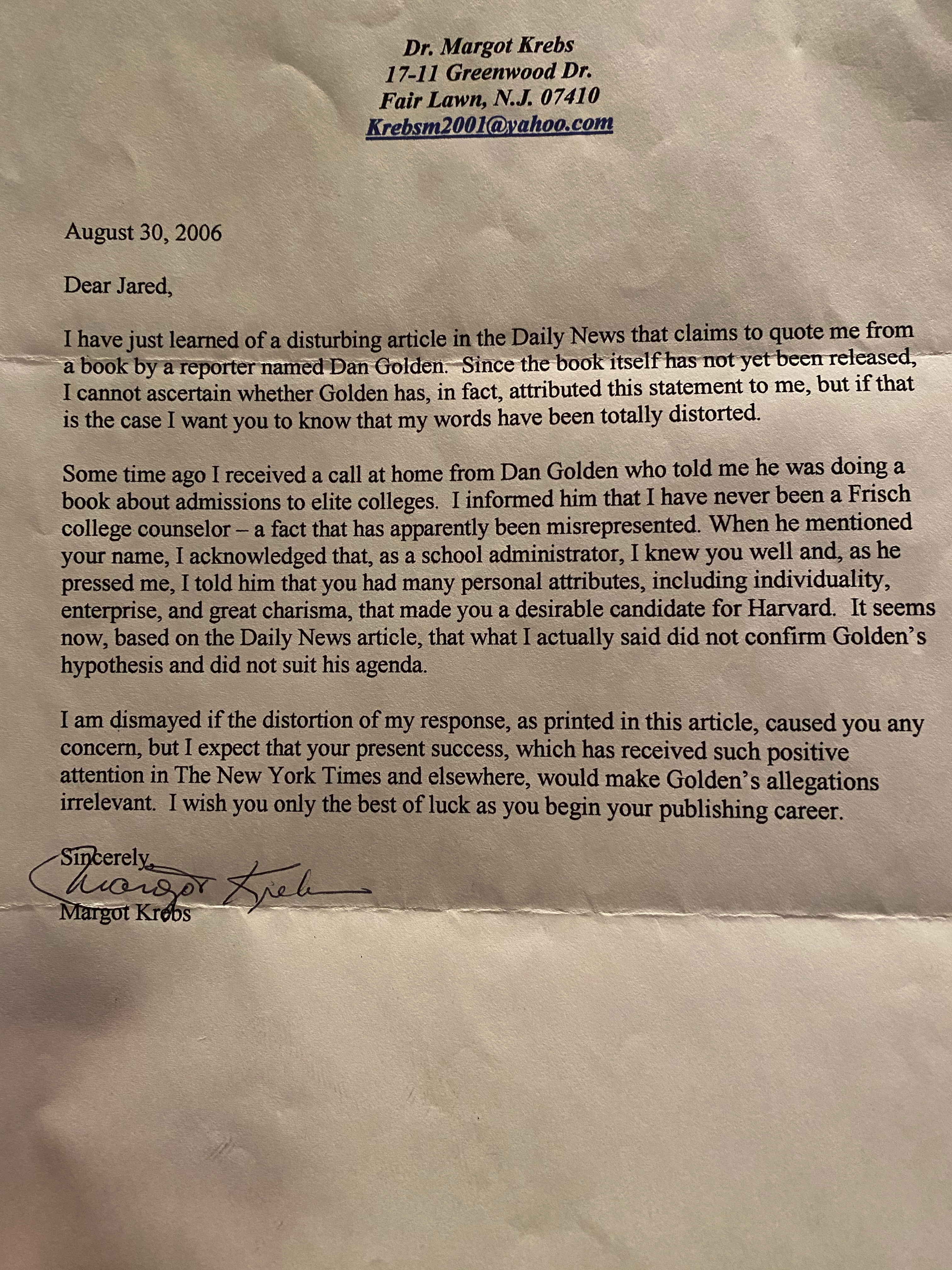
View the full-resolution letter
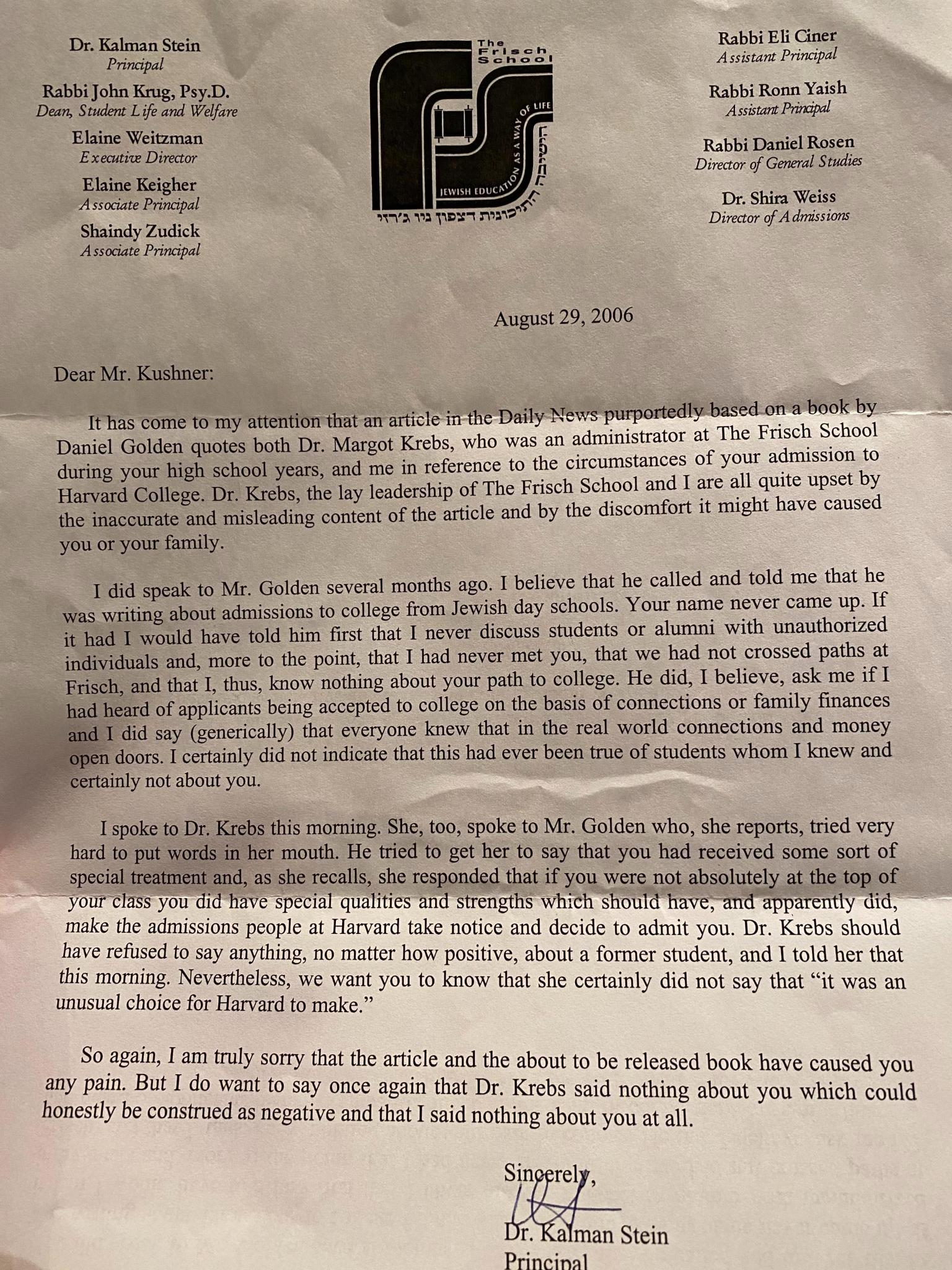
View the full-resolution letter